
Traditionally, businesses focused on identity verification and authentication to ensure customers were who they claimed to be—whether opening an account, applying for a loan, investing, or accessing digital financial services. Today, however, knowing who the customer is may no longer be enough.
As financial services enter an era where more customer data can be used to deliver services, the key question is no longer simply:
“Who is the customer?”
It is increasingly becoming:
“What data does the customer have,
and what do they want to use it for?”
This is where Digital Identity and Data Sharing come together. To support this shift, the Bank of Thailand and relevant agencies developed the Your Data initiative, enabling users to digitally share their financial data held by financial service providers and other organizations with the providers they choose. This allows financial services to go beyond simply knowing who the customer is—and better understand their needs through the data they choose to share.
What Is the Your Data Project?
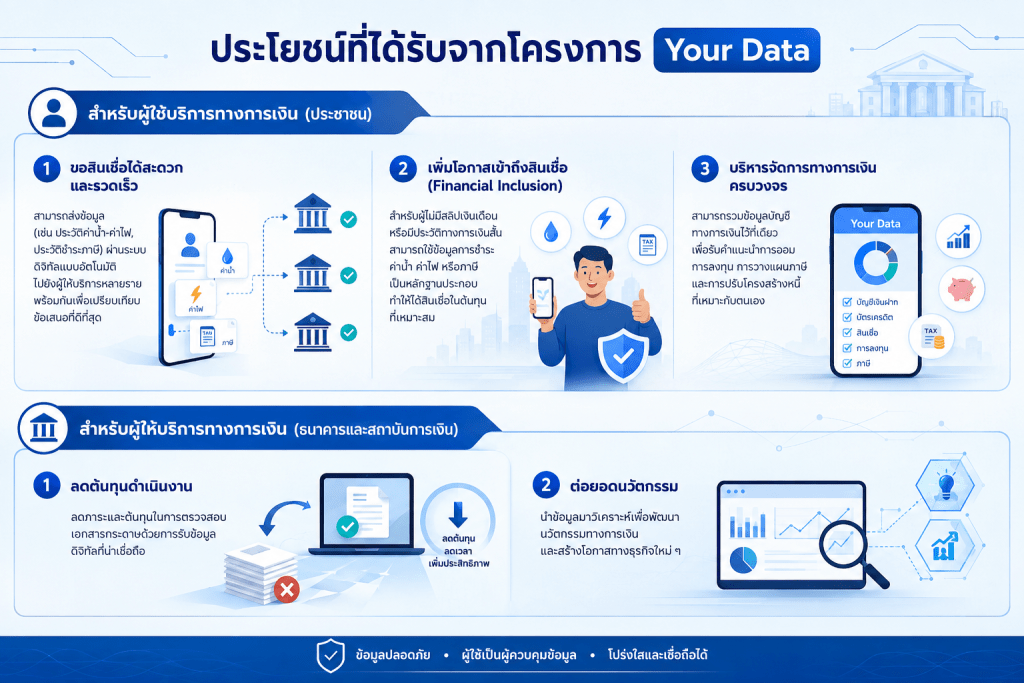
The Your Data Project, or “From Your Data to Better Financial Services” is led by the Bank of Thailand (BOT) in collaboration with 22 government agencies, regulators, and financial service associations, including the Ministry of Finance, the Securities and Exchange Commission (SEC), the Office of Insurance Commission (OIC), the Revenue Department, the Digital Government Development Agency (DGA), electricity and water utilities, and financial sector associations.
The project establishes a mechanism that allows individuals to exercise their right to share their own data held by different organizations with financial service providers of their choice through convenient and secure digital channels—helping them access financial services that better match their needs.
This collaboration will establish a secure data-sharing infrastructure across and beyond the financial sector, creating the foundation for better financial services for individuals and businesses. It will also support the digital economy by ensuring secure data transfers, effective risk management, and broader access to services across lending, investment, insurance, and financial planning.


This shift is changing not only the customer experience, but also how businesses approach Identity and Data Sharing as connected processes. Data sharing is not simply about transferring data between systems—it also requires verifying “who” is requesting the data, “what data” is being shared, and “why” it is being shared.
In the past, customers applying for loans or financial services often had to collect documents from multiple sources, such as bank statements, proof of income, and other information reflecting their financial behavior, before submitting them to a service provider.
This process could be time-consuming and burdensome, requiring customers to collect, verify, and prepare documents according to the requirements of each service.
Your Data shifts this model from “customers providing their data to service providers” to “customers exercising their right to share their own data with the providers they choose.” The data covered by the project will gradually expand across both financial and non-financial sectors, including deposit, payment, credit, investment, and insurance data, as well as information from other organizations, such as water and electricity usage and payment records.
The Bank of Thailand has also published the rules under the Your Data Project to support data-sharing rights within the financial sector. This marks an important step toward putting Data Portability into practice and establishing it as a key component of the financial Digital Ecosystem.
How Does NDID Relate to Your Data?
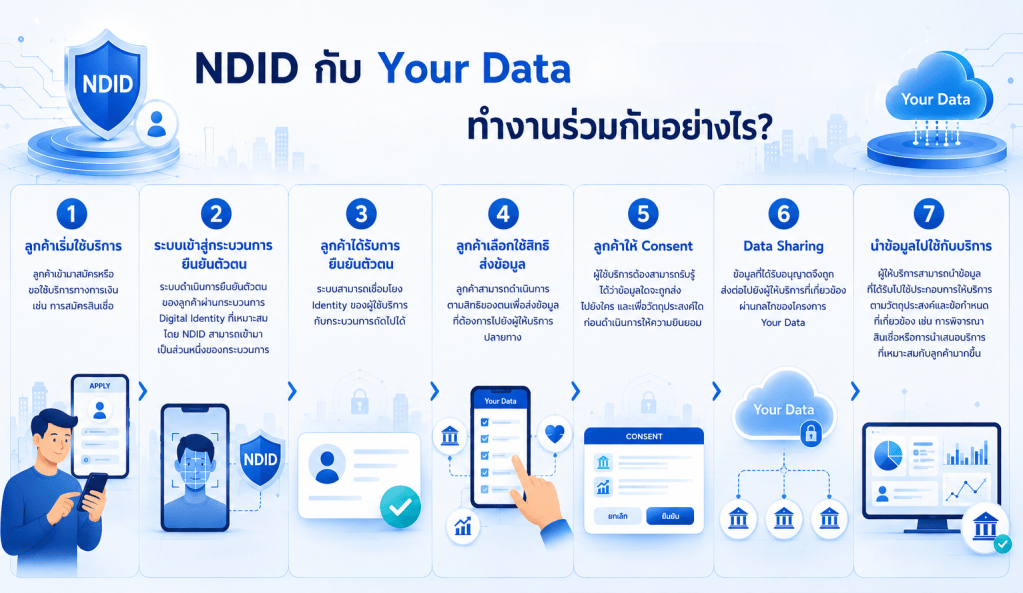
When it comes to Data Sharing, one element cannot be separated from it: Identity. Before a system can authorize a user to exercise their data-sharing rights, it must first know “who is exercising that right?”
In use cases that connect Your Data through NDID, the process can be viewed as the interaction of three key components:
1. Identity — Who are you?
The system must verify that the person taking the action is who they claim to be. This is where Digital Identity and NDID play a key role.
2. Consent — What are you authorizing?
Once the user’s identity is verified, the next step is to ensure that the user understands and can provide consent to the use or sharing of their data for a specified purpose.
3. Data Sharing — What data do you want to share?
Once the user has been verified and provided consent, the data can be shared with the service provider that needs it.
In simple terms:
NDID answers “Who?”
Consent answers “What are you authorizing?”
Your Data answers “What data is being shared and put to use?”
This is where Digital Identity and Data Sharing begin to form a single user journey.
Today, modern financial transactions can be viewed as two key steps:
- Identity Verification: Users complete eKYC through the NDID network to verify their identity accurately and securely.
- Data Sharing: Once identity verification is complete, users can provide Consent to share their data through the Your Data Project, enabling information to be transferred across organizations for services such as loan applications or other financial services.

When these two components work together, data sharing under a framework like Your Data is more than a connection between systems. It requires Identity, Authorization, Consent, and Data Sharing to work together as one process.
From Concept to Real-World Services
Several commercial banks have already announced services for sending and receiving data under the Your Data Project of the Bank of Thailand (BOT), while others are preparing to launch their services soon, including:
- Kasikornbank (KBank)
- Krungthai Bank
- Bangkok Bank
- TMBThanachart Bank (ttb)
- Kiatnakin Phatra Bank (KKP)
- Land and Houses Bank (LH Bank)
- TISCO Bank
- Siam Commercial Bank (SCB)
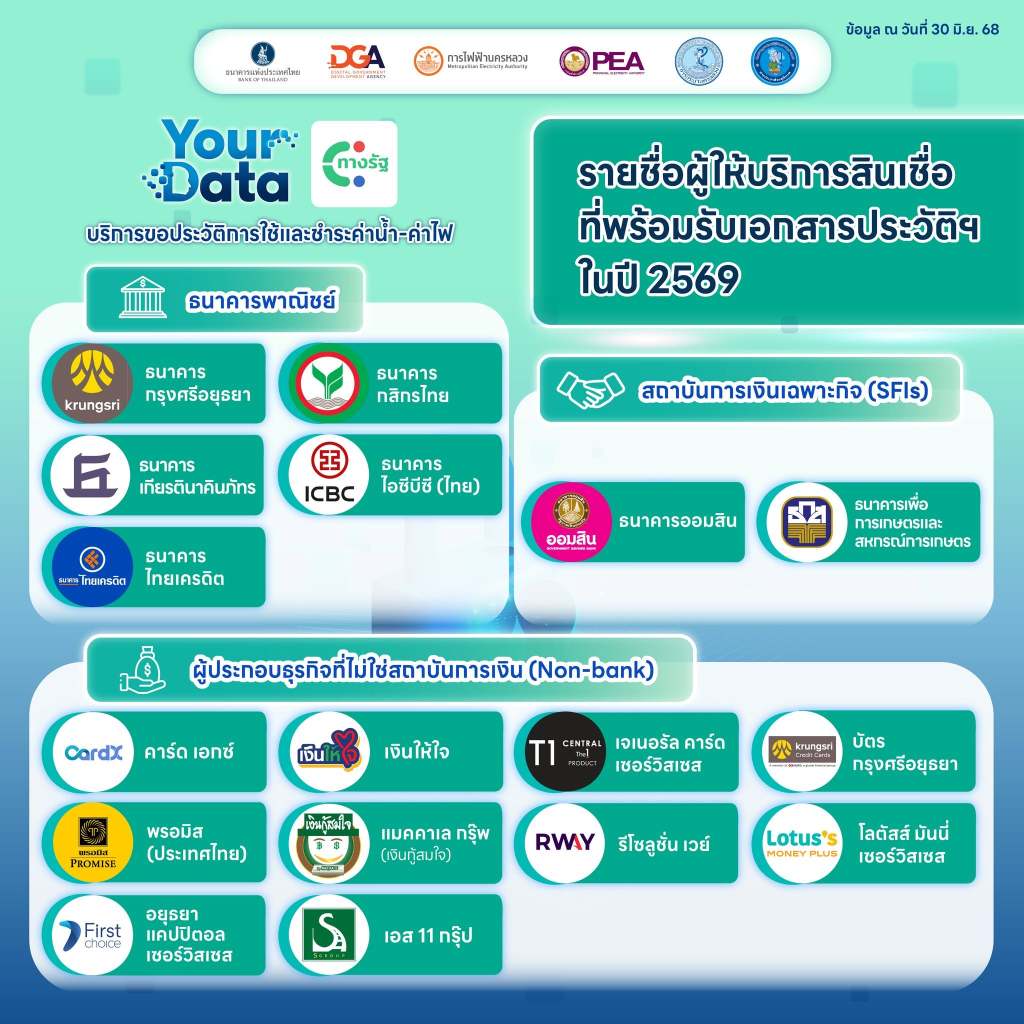
List of Your Data Service Providers: Banks and Non-Banks
(source: FB : ธนาคารแห่งประเทศไทย – Bank of Thailand )
Under the Your Data Project, users can exercise their right to share their own data from one service provider to another to support applications for and access to financial services through digital channels. Data sharing is governed by requirements for personal data protection, security, and applicable laws. The available data-sharing channels and details are outlined below.
| Data Users Can Share with Consent |
Digital Data-Sharing Mechanism | |
| Data Type | Details | |
| Deposit Accounts |
|
Users can exercise their right to |
| e-Money |
|
Users can exercise their right to share financial data held by Thai commercial banks with other service providers through automated digital channels using an Application Programming Interface (API). |
| Credit Cards |
|
Users can exercise their right to share financial data held by Thai commercial banks with other service providers through automated digital channels using an Application Programming Interface (API). |
| Loan Accounts |
|
Users can exercise their right to share financial data held by Thai commercial banks with other service providers through digital channels
|
* Data types available for sharing or requesting may vary by bank. Please check each bank’s current details and terms and conditions.
** The data-sharing channels and related details may change over time. Please refer to the latest information on each bank’s website or the Bank of Thailand’s Your Data Project website.
How Should Businesses Prepare as Your Data Moves Toward Real-World Adoption?
Your Data will impact more than just Data Sharing. It can also reshape how businesses design Digital Onboarding and Customer Journeys. Preparing for Your Data therefore goes beyond connecting APIs or building data-receiving capabilities—it starts with designing the customer journey.
1. Design the Identity Journey to Support the Data Journey
Businesses should understand who the customer is at each stage of the service, what level of identity verification is required, and how the verified identity connects to subsequent processes.
For use cases that connect Your Data through NDID, Identity Verification and Data Sharing should be designed as one seamless journey.
2. Make Consent Part of the Product Experience
Consent should not be treated as a legal notice that users simply click “Accept.” Users should clearly understand:
What are they authorizing → What data → Who receives it → For what purpose?
Effective Consent design is therefore both a Compliance and User Experience consideration.
3. Prepare for Data Integration and Security
Data security is a critical priority. Systems should be capable of securely receiving and transmitting data from relevant sources, with appropriate access controls, security measures, and data management practices in place.
4. Build Systems That Support Integration and Auditability
When Identity, Consent, and Data Sharing work together, systems need to support more than data connectivity. Businesses should consider Data Flow, Access Control, Security, and Audit Trails from the design stage.
This creates a foundation that can scale with future services without requiring the entire process to be redesigned, while supporting auditing, risk management, and issue resolution.
Key areas businesses should prepare for include:
- Verifying the identity of the data owner
- Managing Consent and data-sharing rights
- Defining the data types and purposes for data sharing
- Integrating data with relevant systems
- Ensuring data security and proper data management
- Maintaining audit trails for monitoring and traceability
Preparing Your Business for Your Data with BeID
BeID helps businesses design and develop Digital Identity solutions tailored to their specific use cases and customer journeys.
With expertise in NDID and Digital Identity, BeID can help businesses design and integrate solutions across different use cases—from connecting to the NDID ecosystem as an IdP, RP, or AS, to implementing technologies and processes such as e-KYC, Dip Chip, ePassport, ICAO PKD Integration, Liveness Detection, Facial Recognition, KYB, Authentication, and Consent Management.
Our goal is not simply to help
businesses “verify identities,”
but to make identity verification
an integrated part of the service—one that
works seamlessly in real-world
applications and can evolve as
the Data Ecosystem changes.
Looking for an experienced partner to design and develop end-to-end Onboarding and e-KYC solutions compliant with IAL 2.3 for both individuals and legal entities? Contact BeID to explore how we can help build more secure and seamless digital services.
Source:
Information on the Your Data Project and data-sharing rights is based on the following sources:
- ธนาคารแห่งประเทศไทย: โครงการ Your Data
Overview, objectives, and key concepts of the Your Data Project under Thailand’s financial-sector Open Data framework. - ธนาคารแห่งประเทศไทย: ออกหลักเกณฑ์ภายใต้โครงการ Your Data
Regulatory requirements and implementation guidelines supporting data-sharing rights in the financial sector. - ธนาคารกสิกรไทย: การให้บริการรับส่งข้อมูลภายใต้โครงการ Your Data
An example of data-sharing services provided by a financial service provider under the Your Data Project.


